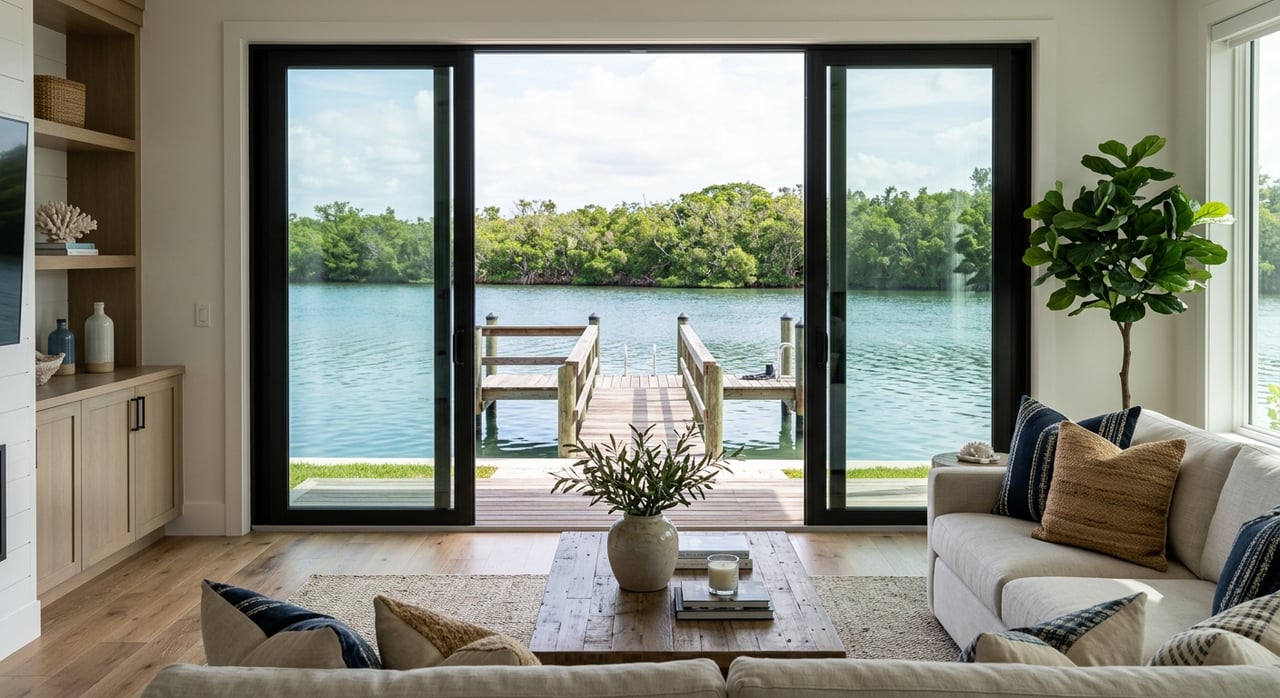
Buying a Jupiter Waterfront Home With Greater Confidence
May 28, 2026
May 28, 2026
Buying a waterfront home in Jupiter can feel exciting right up until the practical questions start piling up. Can your boat clear the bridges? Is the dock permitted? What will flood coverage really cost? If you want the view and a smart long-term purchase, you need more than a quick showing. You need a clear way to evaluate the water, the shoreline, and the ownership risks before you commit. Let’s dive in.
Not all waterfront homes in Jupiter offer the same experience. Some properties are better suited for quick boating access near the inlet, while others may offer canal-front or Intracoastal convenience with a different day-to-day feel.
That is why it helps to separate the search into three parts: how the home lives, how the lot reaches the water, and what the shoreline can legally support. In Jupiter, those are related issues, but they are not the same thing.
Jupiter’s waterfront lifestyle is closely tied to the Jupiter Inlet, the Loxahatchee River, and the Intracoastal Waterway. The town’s Riverwalk, marinas, public docks, and ramps all reflect how important boating and water access are to daily life here.
At the same time, the town also notes that Jupiter’s ocean, inlet, river, canals, and low-lying areas create real flood exposure. So when you compare homes, it is smart to weigh lifestyle benefits and property risks together from the start.
One of the biggest waterfront mistakes is falling in love with a backyard view before confirming the route to open water. In Jupiter, boating access is highly route-specific.
NOAA’s Coast Pilot identifies several bridge-clearance points that can affect your trip, including State Route 707 at 25 feet, U.S. 1 at 26 feet at center, State Route 706 or Indiantown Road at 35 feet at center, Alternate State Route A1A at 25 feet, and the Florida East Coast railroad bridge at 4 feet. A home that works perfectly for one boat may be a poor match for another.
Burt Reynolds Park reinforces this in a practical way. Its east-side ramps require boaters to clear the U.S. 1 bridge in either direction, while the west side is better suited for larger boats.
If you are buying with boating in mind, route planning should happen before you write an offer, not after inspections begin. That simple step can save you time, money, and a lot of frustration.
A dock or boatlift is not just a nice extra. In Jupiter, it is a regulated feature that can directly affect how you use the property.
The town says a building permit is required for docks and boatlifts, and applications are reviewed by multiple departments. These improvements also must meet Chapter 27 Marine Facilities standards for setback, shape, size, and design.
In some cases, other approvals may also be required, including from the Florida Department of Environmental Protection, the Army Corps of Engineers, and an HOA if one applies. That means you should never assume an existing setup is fully compliant just because it is already there.
Seawall work is also regulated. According to the town, whether a seawall is appropriate depends on existing site conditions and town code. If a lot does not already have a bulkhead or revetment, other options such as riprap or an upland retaining wall may need to be considered.
Jupiter recommends a pre-application meeting before filing for seawall-related work. That is a strong sign that shoreline changes should be treated as a real project with review, not a quick upgrade after closing.
One of the smartest moves you can make is to treat the shoreline and permit history as part of the purchase decision. This matters just as much as square footage or finishes.
Jupiter’s dock-related forms ask for details such as existing seawalls, retaining walls, docks, waterway width, mangroves, riparian lines, the mean-high-water line, and water depth at the dock and in the navigable channel. Those are exactly the kinds of details you want to understand before moving forward.
Mangroves deserve special attention. Jupiter states that mangrove removal is not permitted by the town, and trimming or removal is regulated by the Florida Department of Environmental Protection. If mangroves are present, they may affect what changes are possible along the shoreline.
Before writing an offer, you can review the town’s online records portal for permits, deeds, easements, ordinances, and other property records. The town also notes that open permit information can be checked through the Building Department.
In Jupiter, flood risk is not a side note. It should be part of your first-round due diligence.
The town says Jupiter is vulnerable to flooding because of the Loxahatchee River, Jupiter Inlet, and the Atlantic Ocean. It also notes that low-lying areas, canals, lakes, and coastal tidal-surge areas are especially exposed, and that every property has the potential to experience flooding.
Palm Beach County adds that coastal areas are susceptible to storm-surge flooding and that king tides can create sunny-day flooding. That makes flood planning important even when no storm is in the forecast.
For official flood-hazard information, FEMA’s Flood Map Service Center is the source for flood maps and related products. FEMA identifies A and V zones as higher-risk flood areas, and Palm Beach County notes that all county residents live in a flood zone.
Insurance is one of the most important parts of waterfront budgeting, and it should be discussed early. Waiting too long can create surprises that affect your comfort with the purchase.
Florida’s homeowners insurance guidance states that flood damage is not covered by a standard homeowners policy. Flood coverage must be purchased separately.
Florida’s flood guidance also says that both NFIP and private flood policies are available. Under NFIP coverage, building and contents coverage are purchased separately, and there is generally a 30-day waiting period before a new flood policy takes effect unless an exception applies.
If a home is in a high-risk flood area and you are using a government-backed mortgage, flood insurance is required. It is also important to understand Florida’s hurricane deductible rules, because windstorm losses can trigger a separate hurricane deductible that applies on an annual basis.
Jupiter’s 2025 vulnerability assessment looked at sea-level rise, storm surge, groundwater conditions, and extreme rainfall. That is a reminder that waterfront risk is not only about one storm season. It is part of long-term ownership planning.
When a waterfront home checks the style and location boxes, it is easy to move fast. But confidence usually comes from slowing down long enough to answer the right questions.
A practical Jupiter waterfront review should cover boating access, shoreline conditions, permit history, flood exposure, and real insurance costs. It should also look at how the property fits your daily routine, including access to local ramps, marinas, public docks, and waterfront amenities.
Here is a simple checklist to keep in mind before you write an offer.
Jupiter waterfront real estate is more detailed than it may first appear. Two homes can look similar online and offer very different boating routes, shoreline limitations, and insurance profiles.
That is where experienced local guidance can make a real difference. A hands-on agent can help you connect the property search with the town records, the survey, the flood map, and the practical questions that matter most to your lifestyle.
If you are buying a waterfront home in Jupiter, you want someone who can help you look beyond the photos and ask the right questions early. For clear, responsive guidance on Jupiter waterfront homes, connect with Lorie Arena and move forward with confidence.
Stay up to date on the latest real estate trends.

#jupiter

Real Estate
Stuart, FL
Lorie provides a hands-on, client-focused real estate experience defined by clear communication, trust, and responsive service—guiding buyers and sellers every step of the way.

Lorie Arena
2000 PGA Blvd #2100 Palm Beach Gardens FL 33408